Gudi Padwa is celebrated on the first day of the Chaitra month of the Hindu calendar. It is the first day of the year for people of Maharashtra and Konkan region. Gudi Padwa gets it's name from two words, the word Gudi means a flag and Padwa is derived from a Sanskrit word Pratipad which refers to the first day of the bright phase of the moon. This festival is celebrated with family. People worship Lord Brahma and Goddess Saraswati on this day.

Mythology:
Gudi symbolizes Lord Rama's victory over Ravana and thus the happiness and celebrations that followed. Since a symbol of victory is always held high, so is the Gudi (flag). The festival commemorates the coronation of Rama post his return to Ayodhya after completing 14 years of exile. Gudi is said to be a symbol of victory.
The festival is also linked to the mythical day on which Hindu God Bramha created the universe. It is also said that on this day Brahma introduced days, weeks, months and years. Thus Gudi is believed to ward off evil, invite prosperity and good luck into the house.

Preparations for Gudi:
- Wooden pooja chowky
- one big stick (Bamboo)
- one saree or any cloth(red or green or yellow)
- one whole coconut
- Betel leaves
- Batasha (a sweet made up of sugar)
- Mango tree leaves
- Kalash (tie a thread five times on the neck of it and draw KumkumSswastik on it)
- Flowers
- Haldi, Kumkum, Akshada (rice)
- Incense sticks
- Diya
- Toran made up of Mango leaves and marigold flower garland
- A bunch of Neem leaves

Gudi Pooja vidhi:
- Clean houses and courtyards.
- This Pooja vidhi is performed in the morning.
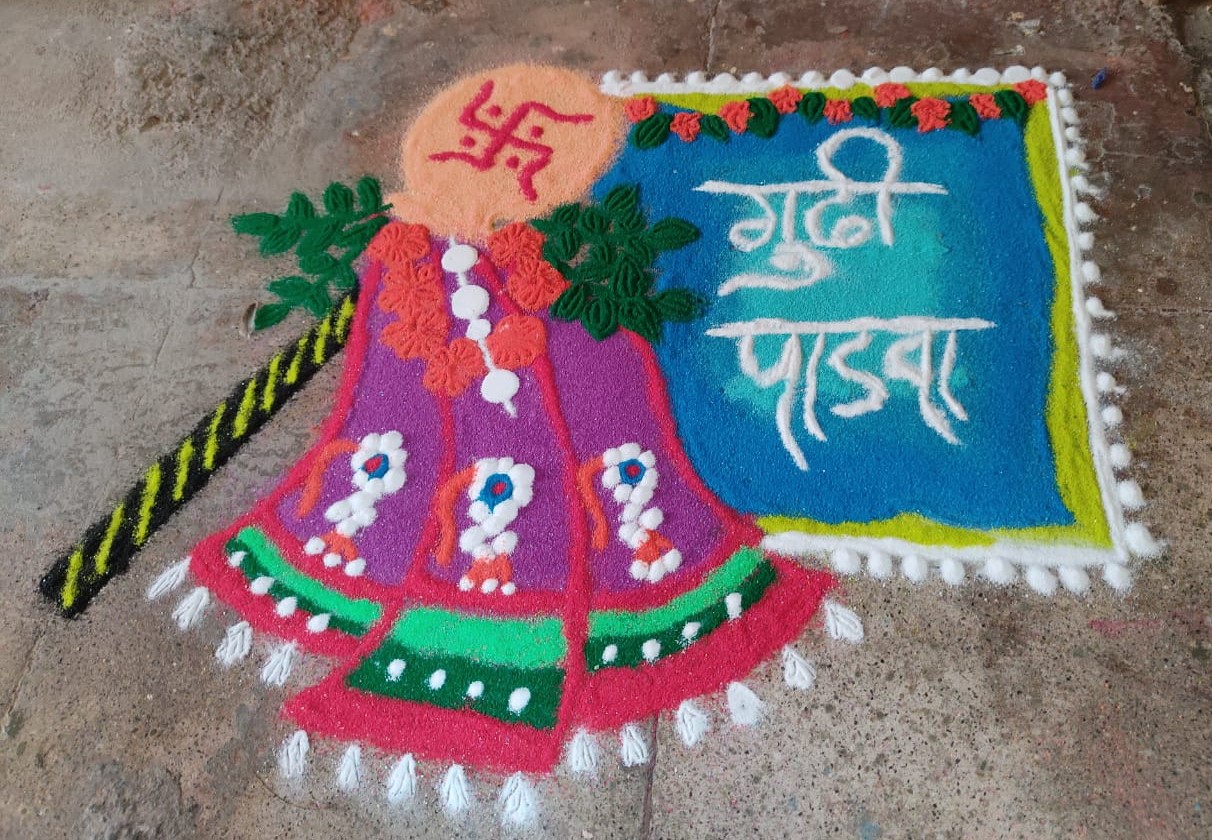
- Draw beautiful Rangoli at the entrance of the house
- First perform a regular pooja of all the deities
- The Gudi is made by tying a Saree on to a long bamboo stick. Take a Bamboo stick, clean it properly and apply five kumkum tikkas over it (on the top)
- On top of the cloth, neem leaves, Batasha mala or gathi (a Maharashtrian sweet preparation), a garland of red or yellow flowers and a twig with mango leaves are tied on the top of the bamboo stick. This stick with the various ornaments is topped off with an inverted silver or copper pot (Kalash).
- Put the Kalash on the top of the stick (as shown in image below). Apply kumkum Swastik on the kalash.
- Now place the Chowky at the entrance and draw small Swastik below it. Decorate the chowky with flowers and also draw Rangoli around it.
- Cover the Chowky with any colored cloth and spread some rice on it (in the center of it).
- Finally keep the Gudi on that rice (on chowky)
- Put two betel leaves (one top of the other) with one betel (Supari) on it.
- Keep one coconut beside Gudi. Apply Haldi kumkum to it.
- Offer prayer to Lord Bramha and Goddess Saraswati.
- Gudi can be placed outside the window or in balcony also.

Celebrations:
On this day, People dress up in traditional attire. All family members wear new cloths and put on jewellery as well. Women draws beautiful Rangoli at the entrance of the house. People consider this day an extremely auspicious for making new purchases, especially of gold and silver.
On this day, special food is prepared including a sweet dish, known as Shrikhand, which is eaten with a type of Indian bread known as Poori. Other special dishes include the sweet Indian flatbread, Aamras and Pooran Poli.

It is believed that hoisting the Gudi outside ones home wards off any evil influences, making way for good luck and prosperity.