Wednesday, 13 January 2021

Makar Sankranti... तिळगुळ घ्या गोड गोड बोला

    Makar Sankranti is one of the ancient festival in India. This festival is celebrated with joy and enthusiasm across all regions of India. It is a harvest festival in India because this festival is celebrated at the time of harvesting. This festival is celebrated in January every year. Most of the festivals in India are related to agriculture, Makar Sankranti is one of them. 


    In Maharashtra, On this day, People exchange til-gul laddoo (sweet made up of sesame seeds and jaggery) and multi coloured halwa (Sugar granules coated in sugar syrup). Married women invite friends/family members and celebrate Haldi-Kumkum. Guests are given til-gul and some small gift, as a part of the ritual. People draw beautiful rangolis at the house entrance. worship of 'Sugad' is important on this day. 'Sugad' is a clay pot filled with ripe grains. women in the family perform 'Sugad puja' on this day.

Sugad Puja vidhi:

Sugad Puja
  • First of all perform regular 'Devpuja' which you do everyday.
  • To perform Sugad Puja, Keep a wooden chowki adjacent to the temple and cover it with a red cloth. Draw a Swastik with red colored rangoli below chowki. Decorate chowki with toran (made up of mango tree leaves). 
  • Take five Sugad (It is a clay pot available easily in market) and clean it properly. Wrap a white thread (five rounds) around the neck of the Sugad. 
  • Apply Haldi kumkum to the Sugad from five sides.
  • Put all the ingredients like wheat grains, carrot, sugarcane pieces, groundnut, sesame seeds or laddoo, halwa (sugar granules), haldi kumkum  in all the five  Sugad. In some places, two Sugad are worshipped. 
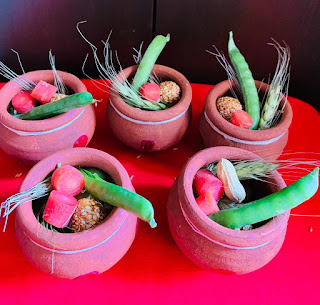
  • Sprinkle some akshada (rice) on the chowky and place five sugad on the chowky.    
  • Place a two betel leaves and one puja supari on it. put it beside Sugad. we call it as "Maanacha Veeda" or "Veeda Supari". Offer haldi kumkum to it.
  • Place a diya (oil/ghee lamp) beside Sugad and lit it while performing puja.
  • Now worship five sugad by offering haldi kumkum to the Sugad and cover all the sugad with a red colored cloth of any lid or diya. Offer flower to each Sugad. It is said that all the Sugad should be covered to maintain prosperity in the house throughout the year. 
  • Show the offering of sesame laddoo and halwa after puja.
       In this way married women (Suvasini) perform this puja. This puja is performed in variations in Maharashtra. Married women can wear black Saree on this day. On this day, People draw beautiful rangoli in front of the house. 


    In the evening all married women invite each other at their house for haldi kumkum where they exchange small gifts (Vaan in Marathi) along with one flower and til-gul. This haldi kumkum program can be celebrated till Rath Saptami. But sugad is to be worshipped on the day of Makar Sankranti.  
    While exchanging til-gul as tokens of goodwill people greet each other with the words "तिळगुळ घ्या, आणि गोड-गोड बोला / til-gul ghyaa, aani goad-goad bolaa" meaning ‘Accept this til-gul (sweet) and utter sweet words’. The underlying thought in the exchange of til-gul is to forget the past ill-feelings and hostilities and resolve to speak sweetly and remain friends.

Sankranti Bornhan / Loot: 
   

    It is a fun filled Maharashtrian tradition to nurture child's immune system. This is a special ceremony organized for the kids in the age group of 1 to 5 years. 'Bor' means berries and 'Nhan' means bath.  It is celebrated for children's good health. It is believed that performing a Bornhan keeps  evil away from kids. 


  • To perform Bornhan, Child is dressed up in any traditional attire preferably in black color dress. 
  • Child have to wear jewelry made out of sugar candies which is named as "Halvyache Dagine" in Marathi. It is easily available in market during Sankranti season.  
  • Invite small children for this ritual.
  • The child is then sit on a Chowky or Paat (wooden rectangular stool). Five married women perform Aarti/Aukshan to the child.    

  • After this, let all other children sit around child. The mother of the child then shower berries, murmura (puffed rice), groundnut, chocolates and candies over the child and other children are asked to collect the fallen items. 


    In this way, this fun filled ritual is celebrated. Now a days people do variety of home decorations for this festivals. Celebration haldi kumkum and Bornhan are carried out on the same day. HAPPY MAKAR SANKRANTI..!!


Flavors of Makar Sankranti across India...

    Makar Sankranti is one of the major Hindu festival in India, dedicated to the Lord Sun (Surya devata). It is a major harvest festival of India which is also known as Maghi. It is considered to extremely auspicious, as it marks the transition of sun to sign of Capricorn or Makar rashi. It also marks as the end of the winter season and beginning of the spring. This festival is also known as \"Uttarayan\" because from this day sun begins it\"s northward journey. On this day, people thank the Lord Sun for a good harvest and offer the first grain to him. 
    This festival is celebrated in almost all parts of the India specially in Maharashtra, Goa, Andhra Pradesh, Karnataka, Kerala, Telangana, Punjab, Rajasthan, Assam and Jammu. There are variations of this festival across India.  

Celebration in different regions of the India:

Maharashtra: On this day, People exchange til-gul laaddoo (sweet made up of sesame seeds and jaggery) and multi coloured halwa (Sugar granules coated in sugar syrup). Married women invite friends/family members and celebrate Haldi-Kumkum. Guests are given til-gul and some small gift, as a part of the ritual. People draw beautiful rangolis at the house entrance. 


Tamil Nadu: This festival is known as "Pongal" in Tamil Nadu. The term Pongal in Tamil means "to boil". On this day, a special dish called \"Pongal\" is prepared and offered to Lord Sun in the morning. Pongal is prepared by boiling harvested rice with milk and jaggery in a clay pot.  


Punjab: In this state. this festival is known as "Lohri". Lohri is celebrated as a bonfire. The sugarcane harvest is celebrated in this festival. One this day, people gather and dance on the folk songs around a bonfire in the evening. 


Andhra Pradesh: It is known as "Pedda Panduga" in Andhra Pradesh. People celebrate this festival with prayer, new cloths and by inviting guests for feasts. The entrance of the house is decorated with \"muggu\" designs i.e. rangoli. 


Karnataka: It is one of the biggest festival in Karnataka. As per rituals, on this pious day, everyone wears new clothes visit and greet their loved ones and exchange a special foodstuff which is a mixture includes ellu (sesame seeds) mixed with groundnuts, coconut and jaggery and the mixture is known as “Ellu Bella” and the ritual is known as “Ellu Birodhu”. 


Gujarat, Rajasthan: In these states, People celebrate this festival by flying kites so it is also known as \"Festival of kites\". In Gujarat, this festival is also known as \"Uttarayan\".


Monday, 11 January 2021

Bhogi Festival... Beginning of Makar Sankranti

    Bhogi is the first day of three-days Makar Sankranti festival. This is celebrated during Makar sankranti when sun changes it’s position from south to the north hemisphere. It is celebrated one day before Sankranti. This festival is celebrated mainly in Maharashtra, Karnataka, Andra Pradesh and Tamil Nadu. In Maharashtra, it is known as Bhogi and Pedda Panduga in many other states. 
Farmers worships Lord Indra (God of Rain) on this day to seek his blessings for a good harvest. Many people worship Sun (Surya Devata) on this day.


Rituals of Bhogi:
  • On this day, People clean and wash their houses and draws beautiful Rangolis at the house entrance. 
  • People put sesame seeds in bathing water. Women wear new cloths and ornaments after taking a holy bath.
  • Food is cooked with a freshly harvested rice, turmeric, Jowar and other vegetables. People cook variety of food like mix vegetable and Bhakari, Khichdi, sesame and jaggery chapati etc. 
  • Women of the family worship all deities and offer food (Naivedya) to all deities.
Tilgul Roti Recipe
   
 To celebrate this day, people wish each other Happy Bhogi Sankranti. In some regions of India, a bonfire is lit with cow dung cake and wood. All old items and cloths are sacrificed in this fire. People chant mantras and sing songs to praise lord while taking rounds around a holy fire.  


Saturday, 19 December 2020

Naag Diwali / Dev Deepawali...

    Dev Deepawali is a festival celebrated mainly in the temples of ‘Khandoba’. Khandoba is a popular Hindu deity mainly in the states of Maharashtra, Andra Pradesh and Karnataka. This deity is considered to be a Kula devata (Ancestral Tutelary deity) of many communities in the state of Maharashtra. Khandoba is traditionally considered as an incarnation of Lord Shiva.

    The first day of Margashirsha month is Dev Deepawali. People celebrate this festival till Panchami of Margashirsha month. One can do this puja during any one of these five days. People celebrate this festival in many ways. Dev Deepavali is celebrated in the belief that Gods descend on the Earth at this grand occasion. 


    In North India, Same festival of Dev Deepavali is celebrated on the full moon day of Kartik month. This is celebrated every year in the Varanasi on the 15th day of Diwali in respect of River Ganga. It is said that the Gods celebrated Diwali on the same day when Lord Shiva killed Tripurasura. On this day, all Diyas are lit on all ghats of Varanasi with a grand Aarti of Ganga.

    On this day, Snakes are worshipped by mothers for the sake of their children. Also, Puja and prayers are performed in Naag temples across many states in Central and south India. People celebrate this festival at home in many ways. Different sweets are made designating each family member and that sweet is called as “Diva” of that family member. It should be as per the choice/likes of the person. It can be any traditional sweet dish like Ladoo, Chirote, Pedha, Gulab jamun, Rasgulla, Shreekhand etc. (for Boys) and Karanji, Baalushahi, Basundi etc. (for girls). Same Diva will be repeated every year. One can change it after five years if they want. We have to keep this Diva (Sweet) in a plate and place a cotton wick (fulwaat) in front of each Diva (sweet) and perform aarti to deity.

Diva (Sweet) with cotton wick beside each of it

Puja Vidhi Naag Diwali:

  • Clean your house early morning and draw a nice rangoli at the entrance of the house.
  • Perform regular puja of all the deity.
  • Take a plate (copper/steel/silver) and draw five Naag (Snake) Devata on that plate with ghee. You can use cotton buds to draw it. 
    Snake made with ghee

  • Keep that plate inside the temple adjacent to all other deities.
  • Perform puja of Naag Devata by Offering Kumkum, akshada and flowers.
  • Offer Naivedya / Prasad to all the deities along with Diva (Sweet). Keep Diva (Sweet) in a plate and lit a cotton wick (fulwaat) which is kept in front of Diva and perform aarti to deity. 
If one couldn’t perform this festival during this month, they can do it on any Sunday of Pausha month (the Tenth month in the Hindu calender).


Thursday, 17 December 2020

Margashirsha Mahalakshmi Vrat... Brings Prosperity

     Margashirsha is the ninth month in the Hindu calendar. Hindu people consider this month as sacred and auspicious month. The Hindu culture is full of rich history, festivals and traditions that has great significance. Each festival has a beautiful story behind it. 

    In the month of Margashirsha, on every Thursday Lakshmi puja is done and fast is observed by devotees. It is believed that, one who observes \"Lakshmi Vrat\" is blessed with spiritual growth and stability in life. This Puja is performed either at home or at Lakshmi Maa temple. The Lakshmi vrat and puja can be performed by both men and women. People who perform this puja have to observe fast for whole day on every Thursday.

Mahalakshmi Vrat Vidhi:

  • To perform puja, Keep a wooden chowky adjacent to the  temple and cover it with red colored cloth. Draw a Swastik below chowky with rangoli. 
  • Draw a Rangoli in front of the house with beautiful colors.
  • Place a photo of Goddess Mahalakshmi on the chowky. 
  • Spread some Rice (Akshada) in front of photo of Goddess Lakshmi. 

  • Take the Kalash and draw a Swastik on it with kumkum. Fill it with water. Put five or seven mango leaves inside the kalash. Put a one rupee coin and a Betel (supari) in the kalash. 

  • Dress the kalash with red colored cloth. 
  • Now place a coconut on the top of the Kalash. The coconut is considered as a Goddess.

  • Decorate a chowky with flowers and Diya. Many people put a Mahalakshmi Mukhavta (Face masks) on Coconut which is easily available in any pooja store during this month. 
  • Offer five fruits to Goddess as Prashad. Put it in front of Kalash. one can also offer some dry fruits to Goddess. 
  • To begin puja, All the offerings first made to the Lord Ganesha. 
  • Now, offer Haldi, Kumkum, akshada and flower to the Goddess Lakshmi idol and kalash.
  • Once this is done, Read "Mahalakshmi Vrat katha" with focused mind. (Book is easily available in any puja store or book store)  
  • Finally perform Aarti of Goddess Lakshmi with offering prayers to Goddess.
  • After the morning puja, the puja and aarti are performed again in the evening and lamps are lit in the courtyard.
    People perfrom this Vrat with the intention of giving wealth, food and prosperity to their family and good health to their family members. In the villages and cities of Maharashtra, this 'vrat' is prepared with enthusiasm. Women go to the market to buy masks, costumes, ornaments and worship materials of the goddess.
    It is believed that those who perform this Vrat with faith and spirit, Goddess Lakshmi will be pleased and will have a grace on them. 

Friday, 27 November 2020

Tulsi Vivah..The marriage ceremony of Lord Krishna


     Tulsi (Holi Basil) is the most sacred plant in Hinduism. Tulsi Vivah is a Hindu ceremonial marriage of the Tulsi plant (Holy basil) to the Lord Vishnu. It falls on the 11th day (Ekadashi) of Shukla Paksha of the Kartik month. This day is also celebrated as Dev Uthani Ekadashi. It is believed that the person who performs the ritual of Tulsi marriage gets as much virtue as one gets from Kanyadaan. 


       The ceremonial festival is performed anytime between Prabodhini Ekadashi and Kartik Pornima. Tulsi wedding signifies the end of the monsoon and the beginning of the wedding season in Hinduism. There is a mythological story behind this ritual.


Mythology of Tulsi Vivah:
    Once upon a time there was a demon called Jalandhar who was a terror to all the world. He had a  wife named Vrinda. Due to her piousness, the demon had secured immortal powers and became invincible. Unless the chastity of Vrinda was challenged, the demon could not be conquered. 
    Even Devtas could not defeat Jalandhar, so they requested Lord Vishnu to find a solution. When leaving for war Vrinda promised Jalandhar that she would do sakalpa for his victory until he would return home. but Lord Vishnu disguised himself as Jalandhar and as she saw him, she left her sankalpa and touched his feet. With her sankalpa destroyed, Jalandhar lost his power and was killed by Lord Shiva and his head fell in Vrinda’s palace. Seeing this she realized it was not her husband but Lord Vishnu. 
    When Vrinda came to know about this, she cursed Lord Vishnu to become a stone named Shaligram and would get separated from his wife. Her curse came true when Lord Vishnu incarnated as Ram and got separated from his wife Sita.  Vrinda then sacrificed herself on her husband’s pyre. After this, Lord Vishnu, converted her soul into Tulsi plant and promised to marry her and that’s how the Shaligram stone married Tulsi plant.
    As per a blessing by Lord Vishnu to marry Vrinda in her next birth, Vishnu in form of Shaligram married Tulsi on Prabodhini Ekadashi. To commemorate this event, the ceremony of Tulsi Vivah is performed.

Celebration Of Tulsi Vivah:

    The marriage of Tulsi with Vishnu/Krishna resembles the traditional Hindu wedding. This ceremony is performed at homes and at temples where a fast is observed on the Tulsi Vivah day until evening when the ceremony begins. It is believed that the soul of Vrinda resides in the plant at night and leaves in the morning. Hence this vivah ceremony is performed in the evening.


Puja Samagri: 
  • Kumkum, haldi, chandan 
  • Flowers
  • Prasad (sesame/Til vadi or ladoo)
  • Five fruits
  • Panchamrut (a mixture of milk, honey/sugar, ghee, gangajal, dahi)
  • Antarpat (a white cloth with red swastik - draw it with kumkum)
  • Akshata (Jowar grain colored with haldi) 
  • Two betel leaves (vidyache paan) and supari (as a symbol of Ganesha)
  • Amla, tamarind, jujube fruit (ber/bor) (you can get it easily in vegetable market)  

   Puja Vidhi:
  1. On the day of Tulsi Vivah, Decorate a Tulsi plant like a bride with a saree and ornaments including Mangalsutra, nath (nose ring), toe ring and bangles.  
  2. Build a mandap around Tulsi Vrindavan with a sugarcane pavilion. 
  3. The groom is an idol or a picture of Lord Krishna (Avatar of Lord Vishnu)  or the Shaligram stone (the symbol of Lord Vishnu). 
  4. Decorate Tulsi devi with chunari, flowers and garlands before wedding.
  5. At first, worship Lord Ganesha. Put it in taaman and bathe it with water and panchamrut. clean the idol properly and place it on a chouwky and offer Kumkum, haldi, chandan and flowers.
  6. Then, put an idol of Lord Krishna in a taaman (a copper/silver plate) and bathe it with water and panchamrut and place it on a chouwky in front of Tulsi vrindavan beside Lord Ganesha.
  7. Perform puja of Lord Krishna and Tulsi devi by offering Kumkum, haldi, chandan and flowers.
  8. Hold Antarpat (a white cloth with a red kumkum swastik in the center of it) between Goddess Tulsi (bride) and Lord Krishna (groom). 
  9. Sing five Mangalashtaka (mangal songs or mantras) and in between sprinkle Akshada on bride and groom while singing mangal songs.  visit this link for Mangalashtak:  Mangalashtaka    
  10. After Mangalashtaka, hold Lord Krishna in both hands and move it around Goddess Tulsi seven times.
  11. At last, Place Lord Krishna near Goddess Tulsi in Vrindavan and shower flowers on them and say "Bor chinch avala, krishna dev savla"
  12. Tie a holy thread (cotton thread) between Tulsi and Lord Vishnu’s idol.
  13. Offer Prasad along with fruits and flowers, and conclude the Puja with Aarti.
Tulsi vivah pooja perfrom in villages

    It is believed that performing Tulsi Vivah is a very auspicious thing for childless parents. They perform the role of the parent of Tulsi plant and give their daughter Tulsi in marriage to Lord Krishna.
After Mangal songs put Lord Krishna near Tulsi
 
   
    On this day, Women of the house draws beautiful rangolis and decorate it with diyas in front of their house to celebrate this marriage ceremony. After the completion of puja people burst crackers and enjoy this day with happiness and joy.

Tulsi theme based Rangolis


Monday, 16 November 2020

Diwali Vibes....Bhaiduj/Bhaubeej

     Bhaubeej ( Bhai Dooj ) is a festival celebrated by Hindus on the second lunar day of Shukla Paksha in the Hindu calendar of a  Kartik month. It is celebrated during the Diwali festival. It is a festival of brother and sister celebrated on the fifth day of Diwali. This festival represents the bond of love between brother and sister.

Bhaubeej: Bond of Love between brother-sister

    On this day, all women worships God Moon first and then to brother. Moon is considered as a first brother to every Woman. All married Women invites their brothers for a meal at their house. 

    After performing Aarti to the Moon, sisters perform aarti to a brother and offer them a whole coconut with a Kardoda (a red thread which a brother tie on their waist on next day) and a cloth ( a dress or a towel or a napkin or a blouse piece if brother is married)  and pray to the Lord for the welfare of their brothers. Brothers in return present gifts to sisters. For those who doesn’t have brother, performs a puja to the Moon. 

Latest Post

Holi.... festival of colors

  Holi is one of the major festivals of India. It is the festival of colors. It is celebrated on the full moon day in the month of Phalgun ...